
Is Your Coolant Killing Your Tools?
How Flood Coolant and Soluble Fluid Decisions Directly Affect Carbide Tool Life
You bought premium carbide. You’re running recommended speeds and feeds. You’re watching your coating spec. And your tools are still dying faster than they should. Before you call your tool supplier, check what’s in your coolant sump.
Coolant is the most common uncontrolled variable in a machining operation. Shops obsess over tool geometry, coating selection, and cutting parameters, then run flood coolant at whatever concentration the last guy mixed and never think about it again. That approach is quietly destroying tool life, degrading surface finish, and costing money on every part that comes off the machine.
This post covers what actually happens at the cutting zone when coolant goes wrong, how to diagnose it, and what to do about it, with a specific focus on flood systems running soluble and semi-synthetic fluids because that’s where most shops have the most room to improve.
What Coolant Is Actually Doing at the Cut
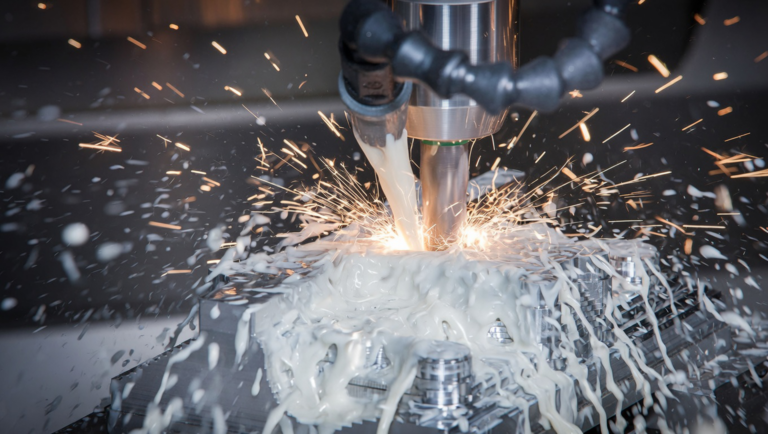
It’s worth starting here because coolant gets mentally filed under “keeps things from getting hot,” which is true but incomplete. The fluid at the cutting zone is doing four things simultaneously:
- Heat extraction: removing thermal energy from the cutting zone before it transfers into the tool substrate or workpiece.
- Lubrication: reducing friction at the tool-chip and tool-workpiece interfaces, which directly affects cutting forces and surface finish quality.
- Chip evacuation: flushing chips away from the cut before they get re-cut, which is a major source of premature flank wear.
- Corrosion inhibition: protecting both the workpiece and machine components between operations.
When your coolant mix is wrong, one or more of those functions degrades. The tool still cuts, but it does so under conditions it wasn’t engineered for. The cumulative effect shows up as premature wear, and it’s not uncommon for shops to blame the tool or the parameters rather than the fluid.
Concentration Is Where Most Shops Go Wrong
Soluble and semi-synthetic coolants are mixed with water at a ratio specified by the manufacturer, typically somewhere between 5% and 12% concentrate depending on the application and the material. That number matters. Running outside of it, in either direction, has real consequences.
Running Too Dilute (Below Spec)
This is the more common problem. Coolant concentration drifts down naturally over time as water evaporates from the sump faster than concentrate. Shops add water to top off and never compensate with additional concentrate. Eventually, they’re running 3% where the spec calls for 8%.
What happens at low concentration:
- Lubrication drops off. Cutting forces increase. The tool works harder to make the same cut.
- Corrosion inhibitors thin out. Rust appears on parts and machine surfaces between shifts.
- Biological growth accelerates. Tramp oil and low-concentration fluid is a breeding environment for bacteria and fungi, which degrades the fluid further and creates odor and health issues.
- Tool life gets shorter. The fluid isn’t providing the film strength it was designed to provide at the cutting interface.
Field Observation
A shop running semi-synthetic at 4% concentration in a stainless steel application was replacing end mills every two to three hours. After bringing the sump back to spec at 9% and cleaning the tramp oil load, tool life nearly doubled. Nothing else changed.
Running Too Concentrated (Above Spec)
The other direction causes different problems. Shops sometimes think more concentrate equals better performance. It doesn’t.
- Foam generation increases, especially with high-pressure delivery. Foam in the cut means inconsistent cooling and poor chip evacuation.
- Residue buildup accelerates on the machine, spindle, toolholders, and workpiece surfaces. This gums up precision toolholding systems.
- Machined surface quality degrades. Excess surfactants in over-concentrated fluid can leave residue that interferes with downstream processes like welding or coating.
- Cost goes up for no performance gain. You’re burning concentrate without benefit.
Checking Concentration: The Refractometer
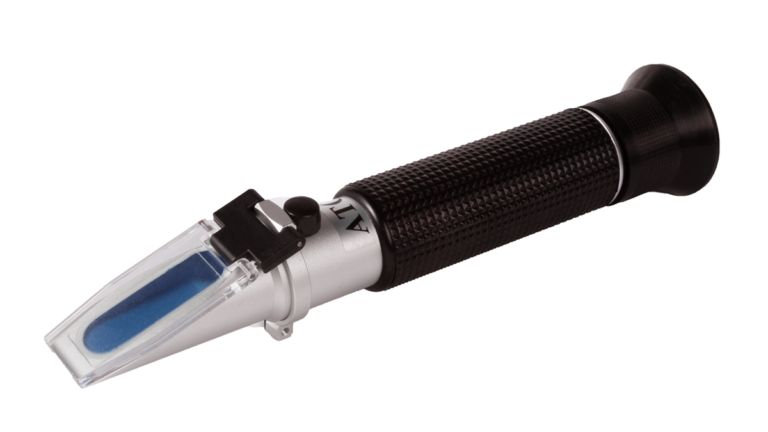
A refractometer is a $30 tool that every shop running soluble or semi-synthetic coolant should have and use daily. It measures the refractive index of the fluid and gives you a Brix reading, which you then multiply by the fluid’s refractometer factor to get actual concentration.
Every coolant manufacturer publishes the refractometer factor for their product. For Hangsterfer’s fluids, that information is available directly on the product data sheet. If you don’t know your fluid’s factor, call your supplier.
The process takes about 30 seconds. Dip a sample from the sump, not from the machine nozzle, because you want to know what’s actually in the reservoir. Place two drops on the prism, close the cover, and read the Brix. Multiply by the factor. Compare to your spec range.
If you’re not checking this at least weekly, you’re running blind.
pH and Why It Matters
Healthy metalworking fluid runs between pH 8.5 and 9.5. Below 8.5, the corrosion inhibitors lose effectiveness and bacterial growth accelerates. Above 9.5, dermatitis risk for operators increases and some materials can see surface discoloration.
pH drift is an early warning signal. If your sump is trending acidic, something is wrong: biological contamination, tramp oil load, high-sulfur metalworking activity, or the fluid is at end of life. pH strips are cheap. Use them.
Tramp Oil: The Silent Contaminator
Tramp oil is machine oil, hydraulic fluid, and way oil that gets into the coolant sump during normal operation. A moderate amount is unavoidable. A heavy load is a problem.
What excessive tramp oil does:
- Creates an anaerobic layer on top of the sump that accelerates bacterial growth underneath it.
- Interferes with the fluid’s ability to wet the cutting zone, reducing the lubrication film.
- Coats chips and machine surfaces, making everything harder to clean and shortening the fluid’s service life.
- Causes foam when the fluid gets agitated at high flow rates.
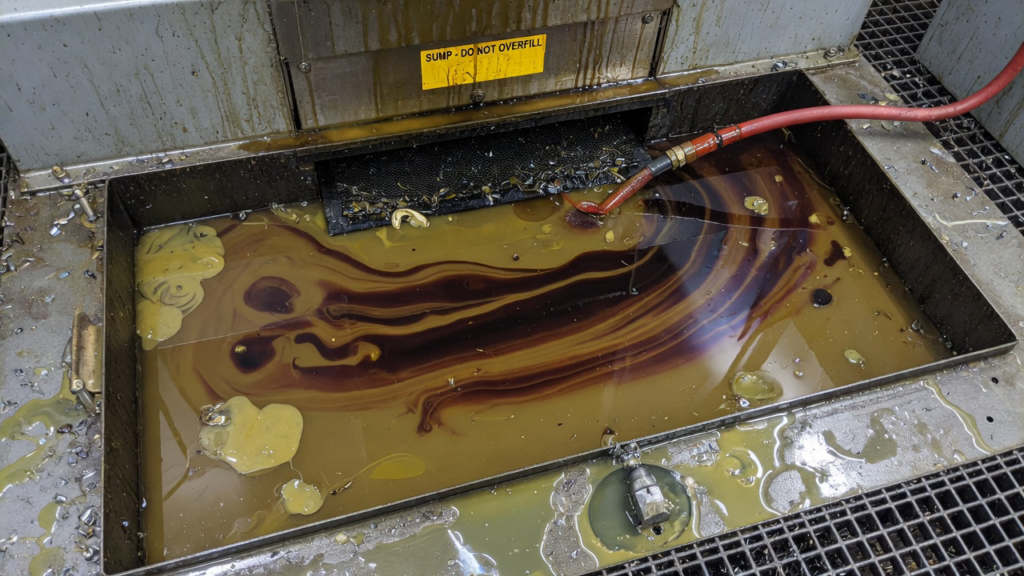
A tramp oil skimmer is one of the highest-ROI purchases a shop can make for sump maintenance. Belt skimmers run continuously and pull tramp oil out of the sump passively, extending fluid life significantly. The fluid you don’t have to replace is the cheapest fluid you buy.
The Coating Connection
This is where the tooling and coolant worlds collide, and where most shops are leaving performance on the table.
High-performance PVD coatings like AlTiN and TiAlN are engineered to form a thermally stable aluminum oxide layer at the cutting zone. That oxide layer is what protects the substrate at high temperatures. Flood coolant applied to these coatings at high cutting speeds can interrupt that layer formation through thermal cycling, the rapid alternation between heat at the cutting edge and cold fluid in the gap.
The result is micro-cracking in the coating that accelerates wear. The tool costs more, runs shorter, and the shop assumes they got a bad batch.
The fix depends on the operation. For high-speed finishing on hardened steel with AlTiN tooling, dry or MQL often outperforms flood cooling. If your process requires flood, confirm your coolant is compatible with wet cutting at elevated temperatures, and make sure your concentration is in spec because a dilute coolant has less thermal buffering capacity than a properly mixed one.
For Additional Context
For a full breakdown of flood vs. MQL vs. dry cutting strategy, see our post: Flood Coolant vs. MQL vs. Dry Machining: Choosing the Right Strategy (wcchapman.com)
Application-Specific Considerations
Carbon and Alloy Steel
Soluble and semi-synthetic fluids work well here. Run at the manufacturer’s spec for the operation type, higher end of the range for roughing where heat generation is highest, lower end for finishing where surface finish is the priority. Keep concentration consistent. Steel is forgiving compared to stainless or exotic alloys, which is why bad coolant habits often go undetected until a shop starts running more difficult materials.
Stainless Steel (304, 316, 17-4 PH)
Stainless work-hardens fast. The cutting zone needs adequate lubrication to keep cutting forces manageable and prevent built-up edge. Under-concentrated soluble coolant on stainless is a guaranteed tool-life problem. Run at the upper end of the recommended concentration range. High-chlorine formulations are effective but check the workpiece spec for chlorine restrictions if parts go into aerospace or medical applications.
Aluminum (6061, 7075)
Aluminum has its own rules. The material is sticky relative to ferrous workpieces, which causes built-up edge on the tool face. Most high-performance coatings for aluminum (ZrN, DLC, uncoated carbide) are chosen specifically to reduce aluminum adhesion. Your coolant should complement that by providing adequate lubricity at the rake face.
Avoid high-sulfur formulations on aluminum, the chemical reaction can discolor parts. Check that your soluble coolant is approved for aluminum if you’re running mixed-metal operations in the same sump.
| Material | Concentration Range | Watch Out For |
| Carbon / Alloy Steel | 5-8% | Tramp oil, pH drift |
| Stainless Steel | 8-12% | Under-concentration, chlorine limits |
| Aluminum | 5-8% | High-sulfur formulations, staining |
| Titanium | 8-12%, high-pressure preferred | Heat buildup, coating adhesion issues |
| Cast Iron | Dry preferred; flood 5-7% if required | Water-based coolants accelerate corrosion |
Sump Maintenance: What a Proper Program Looks Like
Fluid maintenance isn’t a once-a-week check. It’s a system. Here’s what a basic program looks like for a shop running soluble or semi-synthetic flood coolant:
- Daily: Refractometer check. Visual inspection for color change or odor. Verify nozzle positioning.
- Weekly: pH check. Top off concentrate to maintain spec if concentration has drifted. Skim visible tramp oil manually if no skimmer is installed.
- Monthly: Full sump sample for biological count if your fluid supplier offers analysis. Review tramp oil load. Check for foam-generating conditions.
- Quarterly or at sign of degradation: Full sump cleanout. Dump, clean, and recharge with fresh fluid. Don’t try to rescue a biologically contaminated sump by adding more concentrate.
Reading the Symptoms
Your sump and your tools will tell you when something is wrong. You just need to know what to look for:
| Symptom | Likely Cause | First Step |
| Short tool life on carbide | Under-concentration or tramp oil load | Check refractometer, check tramp oil |
| Rust on parts or machine | pH below 8.5 or low concentration | Check pH and concentration |
| Odor in the shop (“Monday morning smell”) | Bacterial growth over the weekend | Check pH, consider biocide addition |
| Foam at the nozzle | Over-concentration or tramp oil contamination | Check concentration, skim tramp oil |
| Surface finish degradation | Poor chip evacuation or low lubricity | Adjust nozzle direction, check concentration |
| Built-up edge on tools | Low lubricity at cutting interface | Increase concentration or switch fluid type |
The Right Fluid for the Job
Coolant selection and maintenance are not one-size-fits-all. The right fluid depends on your materials, your machining operations, your machine tools, and your maintenance capacity. Hangsterfer’s fluids, which Chapman stocks and supports, are formulated specifically for demanding CNC applications and come with technical data sheets that specify concentration ranges, refractometer factors, and application guidance.
If you’re not sure whether your current coolant is the right product for your operation, or if you’ve been running the same drum for years without evaluating it, that’s a conversation worth having. The cost of switching to a better-suited fluid is almost always less than the cost of the tooling you’re burning through with the wrong one.
Talk to Chapman
W.C. Chapman & Sons stocks Hangsterfer’s metalworking fluids along with the full range of cutting tools to pair with them. Our team can help you match the right fluid, the right concentration, and the right tooling to your specific operation.
Browse our Metalworking Fluids and CNC Cutting Tools catalogs at shop.wcchapman.com, or call us at 410.686.6860.